Witchcraft symbols are a kind of shorthand for magick: a single shape can hold an idea, a prayer or a protection charm, and you can draw, wear or carve them with almost nothing.
Some of the symbols witches use today are thousands of years old, some come from medieval folk magick, and some were shaped by modern Wicca in the last century. Knowing where each one comes from helps you use it with respect and with confidence.
In this guide, we'll go through the most common witchcraft symbols and meanings, from the pentacle and the triple moon to the triquetra, the ankh and old protection marks carved into English houses. You'll also find a quick reference table, a section on protection symbols and simple ways to use symbols in your own practice.
How to Use a Witchcraft Symbol in 5 Steps
- Choose one symbol whose meaning matches your goal, such as protection, balance or new beginnings.
- Learn its origin. Know which culture it comes from and what it meant there.
- Draw it by hand on paper while you focus on your intention. Your own drawing carries more of you than a printout.
- Place or carry it: carve it on a candle, trace it over a doorway, wear it, or tuck it under your pillow.
- Note the results in your Book of Shadows so you learn which symbols work best for you.
Wiccan Symbols and Their Meanings
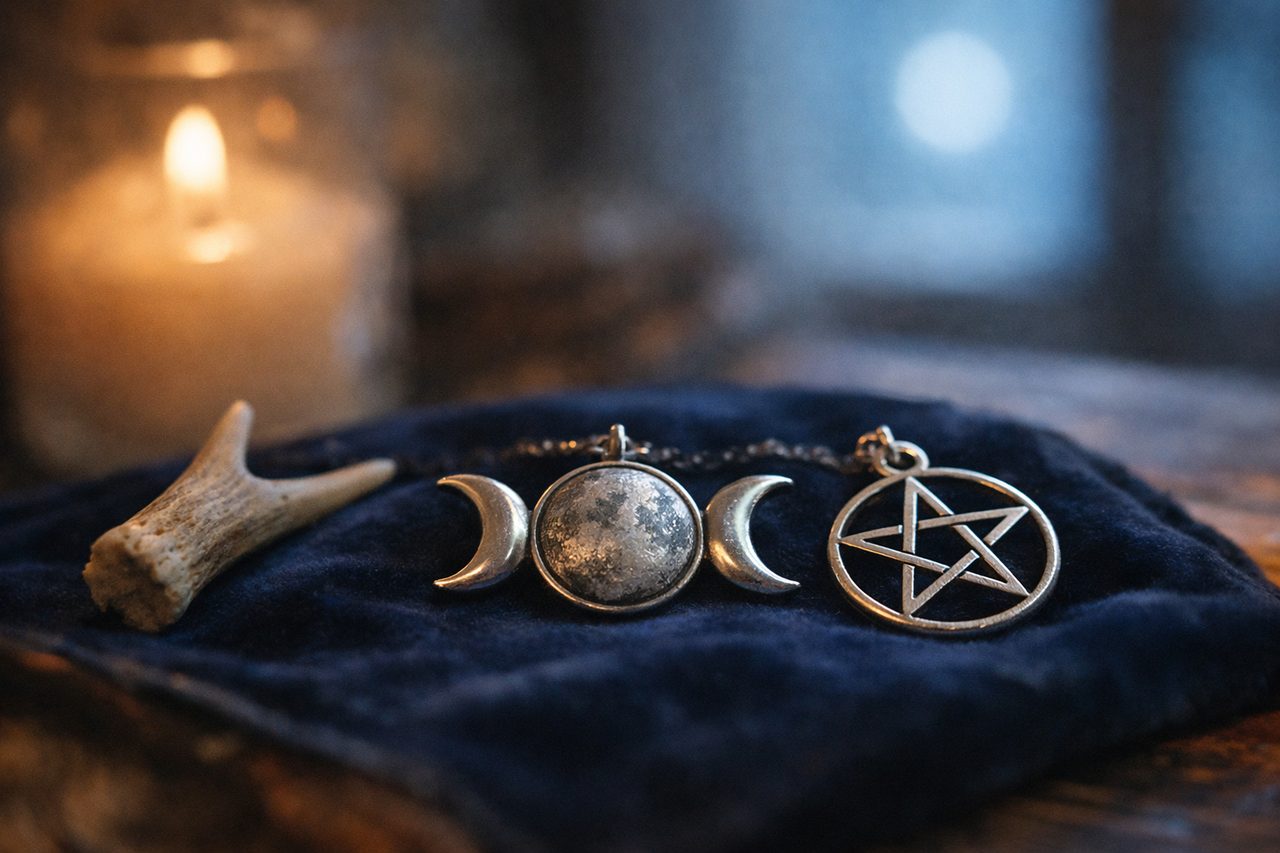
These are the symbols you'll see most often in Wicca and modern witchcraft. They're all fairly simple shapes, which makes them easy to draw and remember.
Pentagram and Pentacle
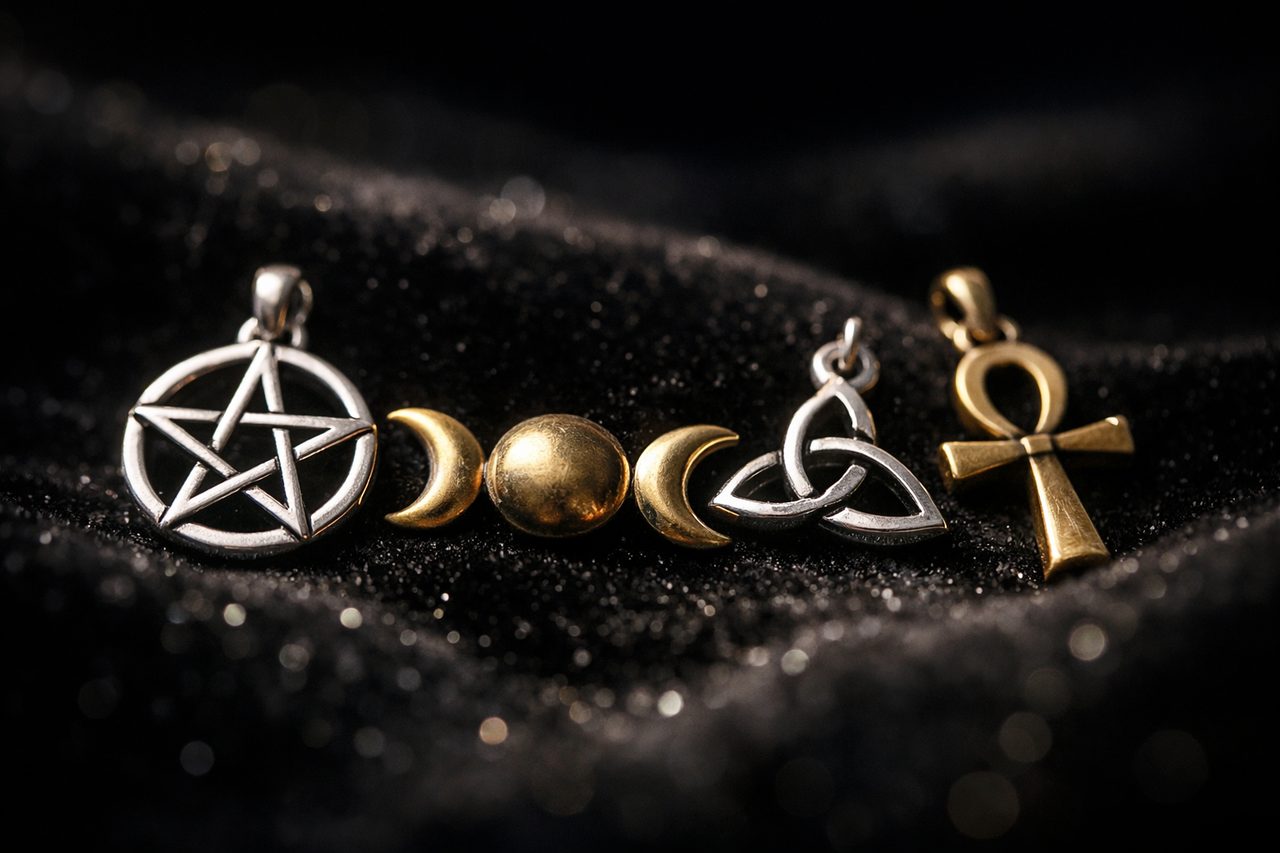
A pentagram is a five-pointed star drawn in one continuous line. When it's set inside a circle, it's called a pentacle. The five-pointed star is very old and has meant different things to different people. In the 14th-century English poem Sir Gawain and the Green Knight, for example, the knight carries a pentangle on his shield as a sign of his virtues.
In Wicca, the five points stand for earth, air, fire, water and spirit, with spirit at the top, and the circle shows that everything is connected and protected. Wiccans usually draw it point up. A pentacle is also an altar tool: a flat disc engraved with the symbol, used to bless and charge objects. It's the best-known Wiccan symbol, and since 2007 it has been one of the emblems the U.S. Department of Veterans Affairs allows on veterans' headstones.
Triple Moon and the Triple Goddess
The triple moon shows a waxing crescent, a full moon and a waning crescent side by side. It represents the Goddess and the cycle of the moon: growth, fullness and release. Many witches also link the three phases with the Maiden, the Mother and the Crone, the three faces of the Triple Goddess.
Goddesses with three forms are ancient. The Greek goddess Hecate, for example, was often shown as three figures standing back to back. The specific Maiden, Mother and Crone idea, though, was made popular by the poet Robert Graves in The White Goddess (1948), and it was then taken up by Wicca. Our article on Hecate, the triple goddess explains more.
The Horned God Symbol
The Horned God symbol is a circle topped by a crescent turned upward like a pair of horns. It represents the God in Wicca: the wild, the forest, animals, the hunt and the turning of the seasons. Wiccans often connect him with antlered figures like the Gaulish god Cernunnos, whose name appears on a carved stone pillar from 1st-century Paris. Learn about him in the Moon Goddess and the Horned God.
Elemental Symbols: The Four Triangles
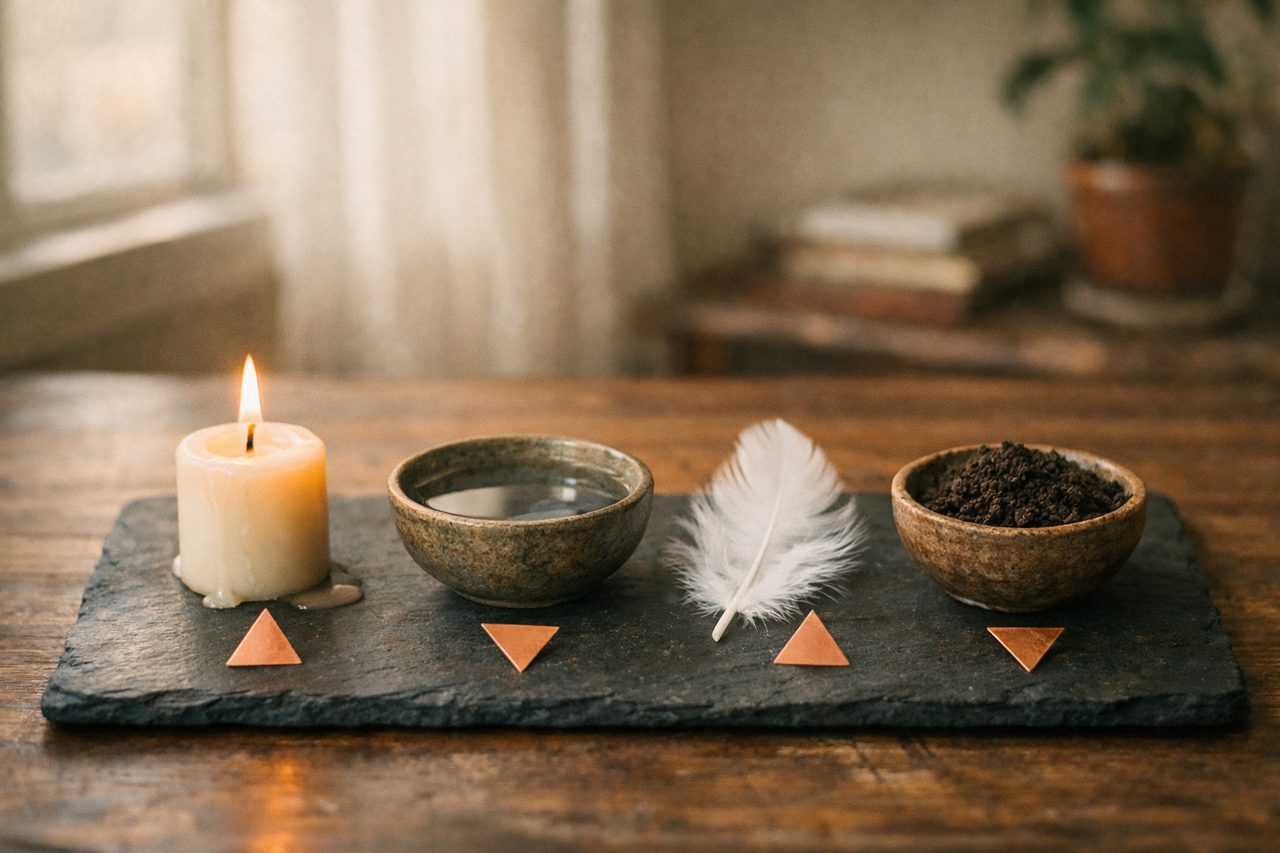
The four elements are usually drawn as triangles. These signs come from European alchemy, and witches borrowed them because they're quick to draw on candles, jars and paper.
- Fire: a triangle pointing up, like a rising flame. Passion, courage, change.
- Water: a triangle pointing down, like water flowing into a cup. Emotions, intuition, healing.
- Air: an upward triangle with a line across it. Thought, communication, new ideas.
- Earth: a downward triangle with a line across it. Stability, money, the body, home.
Combine an element symbol with a matching candle color for a simple spell. For example, draw the earth triangle on a green candle for steady finances. Our candle color meanings guide will help you pair them.
Ancient and Folk Symbols Witches Use
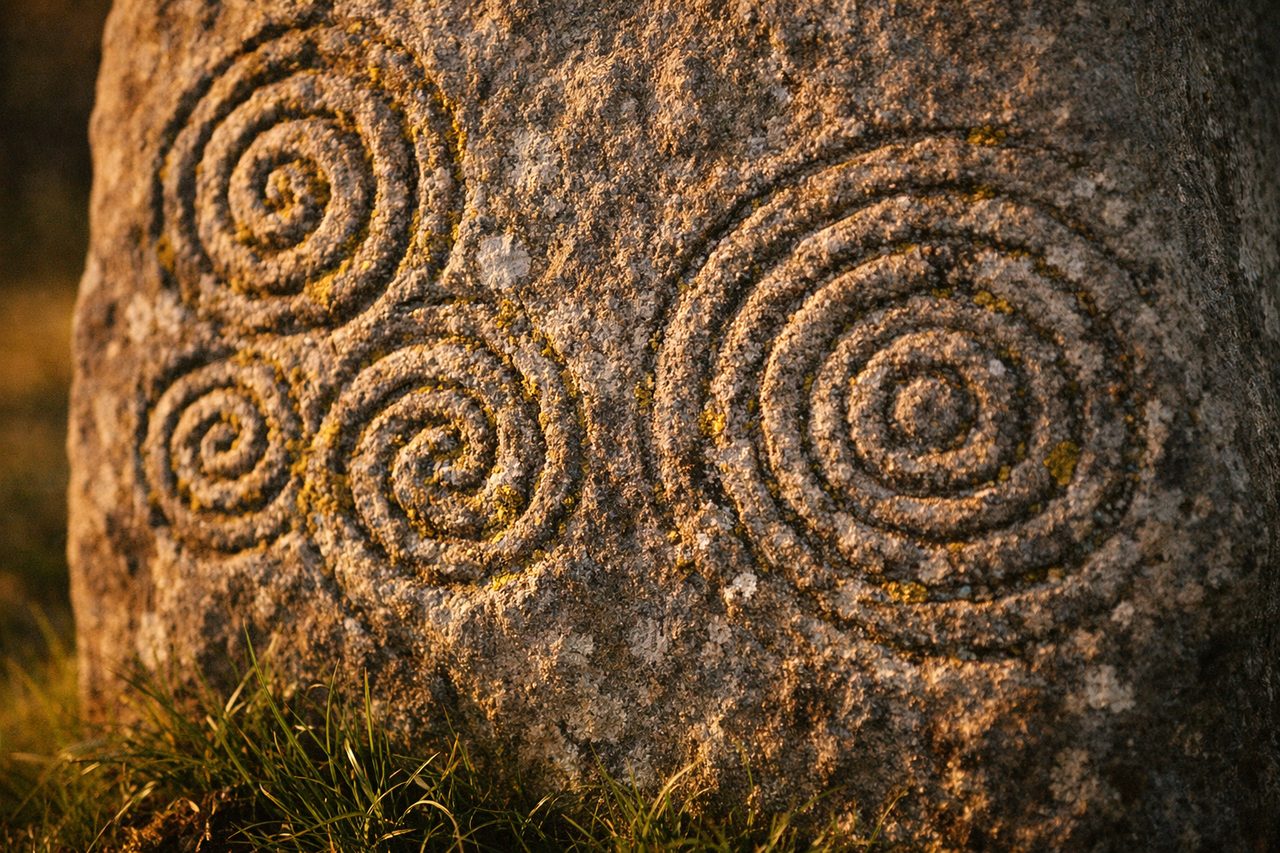
These symbols weren't invented by witches. They come from older cultures and folk traditions, and they're used today by many people, Pagan and not. A little respect for their roots goes a long way.
Triquetra
The triquetra is three interlocking loops, often with a circle woven through them. It appears in early medieval Celtic and Norse art, including the Book of Kells, and Christians have long used it as a symbol of the Holy Trinity. Modern witches often read it as the Triple Goddess, as land, sea and sky, or as mind, body and spirit. It's a lovely symbol for unity and protection, and many people know it from the cover of the Book of Shadows on the TV show Charmed.
Spiral
The spiral is one of humanity's oldest symbols. Famous examples are carved on the stones of Newgrange in Ireland, a passage tomb built around 3200 BCE. No one knows exactly what the builders meant by it. Witches today use the spiral for growth, the cycles of life, the journey inward during meditation and the Goddess. A spiral drawn outward can mean expansion, and one drawn inward can mean drawing energy in.
Ankh
The ankh, a cross with a loop at the top, is an ancient Egyptian hieroglyph meaning "life". Egyptian art often shows gods holding it, sometimes offering it to the king as the breath of life. Some modern witches wear it for vitality and long life. Remember that it's a sacred symbol of Egyptian religion, still honored today by Kemetic practitioners, so it's worth learning about its background before you use it.
Eye of Horus
The Eye of Horus, or wedjat, also comes from ancient Egypt. In myth, the god Horus lost his eye in a struggle with the god Seth, and it was later restored. The eye became a sign of healing, wholeness and protection, and Egyptians wore it as an amulet in life and placed it with the dead. Witches who use it today often do so for protection, ideally with an understanding of the Egyptian story behind it.
Witch's Knot
The witch's knot is a design of four interlaced loops drawn in one continuous line. You'll often read that it's an ancient charm, but its early history is hard to trace, so treat bold claims about its age with care. Today many witches draw it for protection, for binding a spell together and in knot magick.
Protection Symbols in Witchcraft
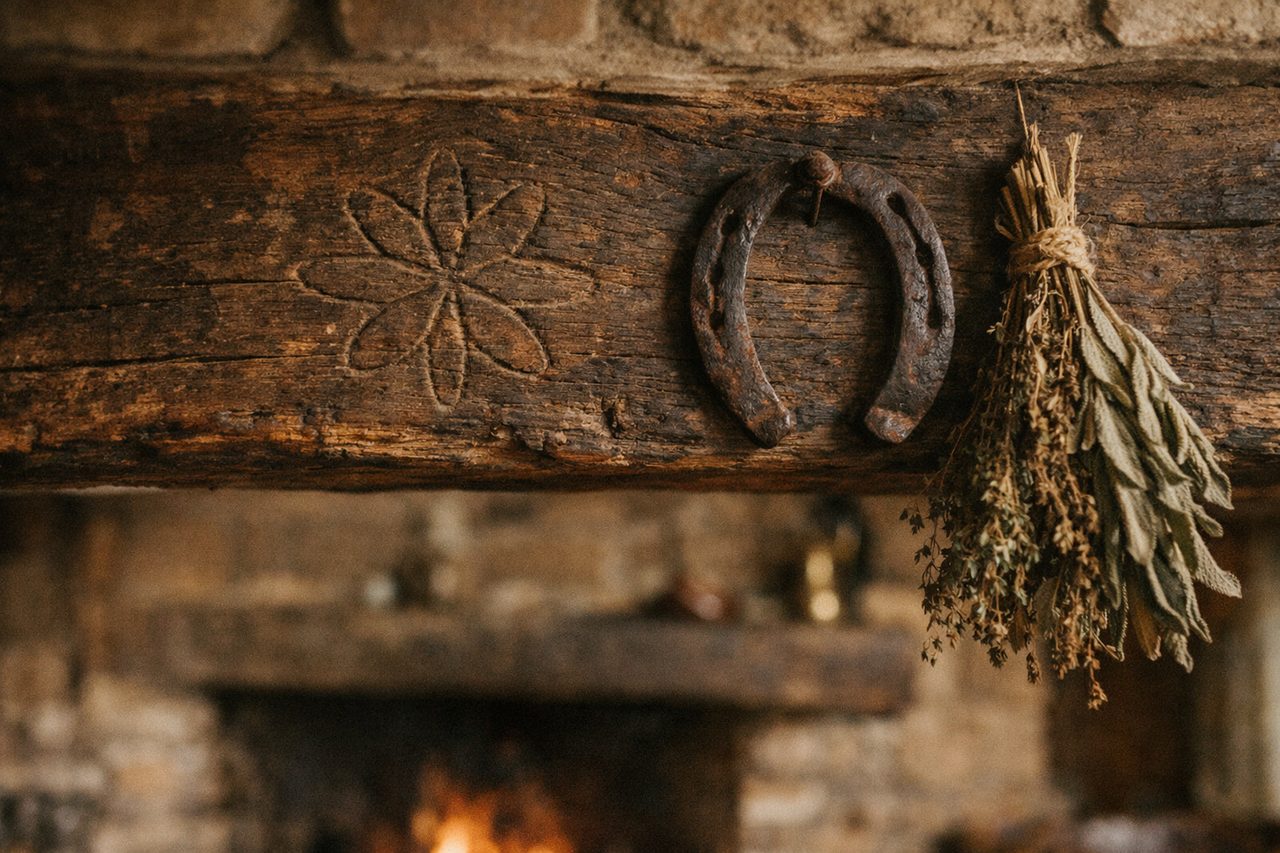
Protection symbols are among the most searched witchcraft symbols, and for good reason. They're simple, discreet and easy to add to a home. Here are the most popular.
Hexafoil or Daisy Wheel
The hexafoil, or daisy wheel, is a six-petaled flower drawn with a compass. Historians and archaeologists have found thousands of them carved into old English churches, barns and houses, often near doors, windows and fireplaces, the places where people felt a home was open to harm. Most date from roughly the 16th to the 18th centuries, and many researchers think they were made to protect the building. These are called apotropaic marks, from a Greek word meaning "turning away".
Thor's Hammer (Mjölnir)
Mjölnir, the hammer of the Norse god Thor, protected gods and people from chaos in the myths. Small hammer pendants have been found across Viking Age Scandinavia, and many Heathens wear one today as a sign of their faith. In 2013 it was also added to the list of headstone emblems approved by the U.S. Department of Veterans Affairs. Sadly, a few hate groups have misused Norse symbols, and Heathen organizations work hard to reclaim them for what they truly are.
Algiz Rune
Algiz (ᛉ) is a rune of the Elder Futhark that looks like an upturned hand or the antlers of an elk. Its original name and meaning are reconstructed by scholars, so we can't be sure what it meant to early rune carvers, but modern rune readers link it strongly with protection and divine guidance. Learn the other runes in rune casting for beginners.
Other Protection Symbols
- The pentacle: drawn in the air or on a door to seal a space.
- Iron horseshoe: hung over doors in British and Irish folk custom for luck and protection.
- The Eye of Horus: for watchful protection, as described above.
- Hamsa and nazar: the hamsa (a protective hand) and the nazar (a blue eye bead) are much loved charms against the evil eye in the Middle East, North Africa and around the Mediterranean, used in Jewish, Muslim and Christian homes alike. If you use them, honor the cultures they belong to.
Our protection spells for your home pair beautifully with these marks, and a witch bottle is another time-tested way to guard a doorway.
Witch Tools as Symbols: Besom and Cauldron
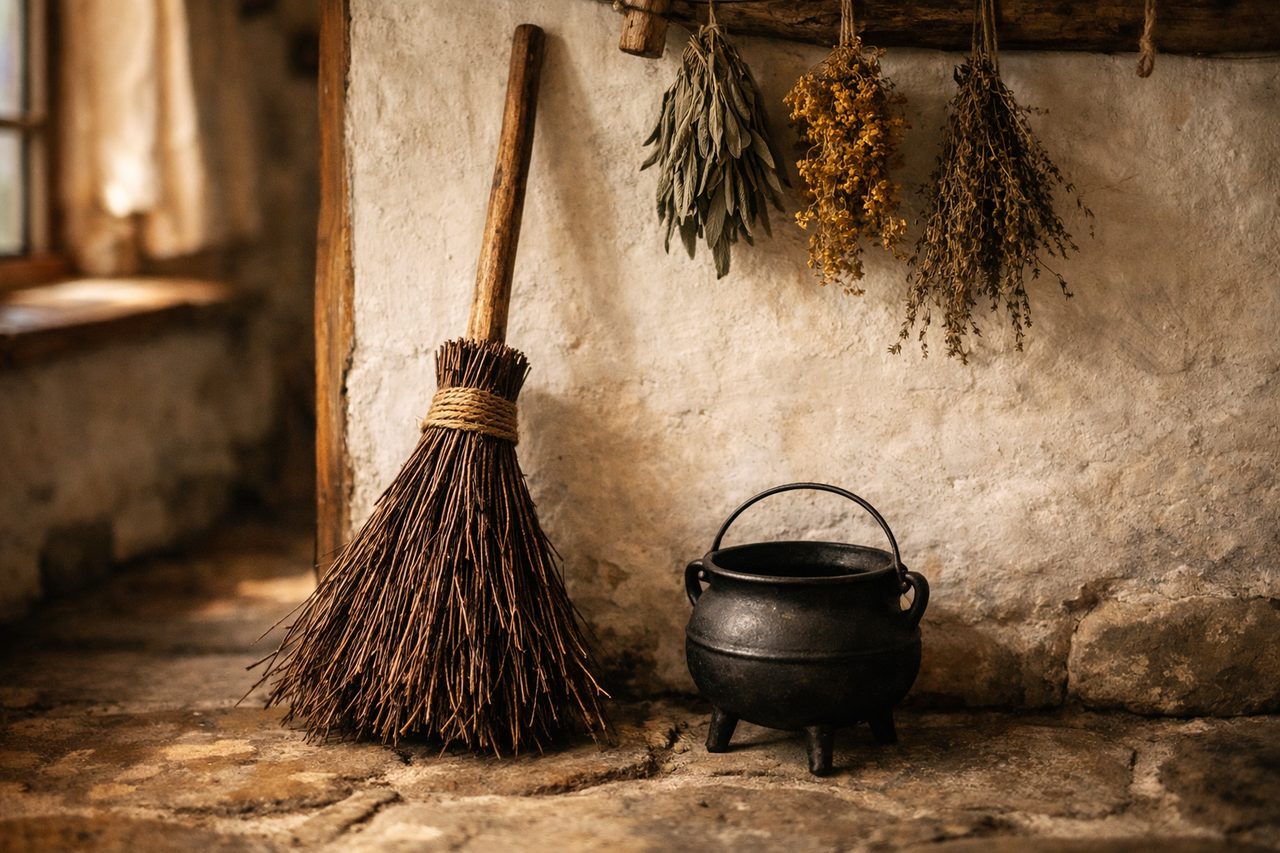
Some of the most powerful witchcraft symbols are tools you can actually hold.
- Besom (broom): the besom stands for cleansing and for the threshold between spaces. Many witches sweep a ritual space before casting a circle, sweeping the air rather than the floor, and hang a besom by the door for protection. It's also a sign of the hearth and home.
- Cauldron: the cauldron stands for transformation, abundance and the womb of the Goddess. In Welsh legend, the enchantress Ceridwen brewed a potion of wisdom in her cauldron, and in Irish myth the Dagda owned a cauldron that never ran empty. On a Wiccan altar, it's the element of water and the Goddess.
Learn where these tools go on the altar in our beginner's guide to Wiccan altars.
Witchcraft Symbols Chart
| Symbol | Origin | Meaning | How witches use it |
|---|---|---|---|
| Pentacle / pentagram | Ancient five-pointed star; central in modern Wicca | Four elements plus spirit, protection | Altar disc, jewelry, drawn over doors and candles |
| Triple moon | Modern Wicca, based on the moon phases | The Goddess, Maiden, Mother and Crone | Moon rituals, altar decoration, jewelry |
| Horned God | Modern Wicca, inspired by antlered gods like Cernunnos | The God, nature, wildness | God candles, sabbat altars |
| Elemental triangles | European alchemy | Fire, water, air, earth | Carved on candles, drawn on spell jars |
| Triquetra | Early medieval Celtic and Norse art | Unity, the number three, protection | Book of Shadows covers, charms |
| Spiral | Prehistoric carvings, such as Newgrange | Growth, cycles, the inner journey | Meditation, growth spells |
| Ankh | Ancient Egypt | Life | Jewelry and charms for vitality |
| Eye of Horus | Ancient Egypt | Healing, wholeness, protection | Protective amulets |
| Witch's knot | Folk design, history uncertain | Binding, protection | Knot magick, protection charms |
| Hexafoil (daisy wheel) | Early modern English buildings | Turning away harm | Drawn near doors, windows and hearths |
| Thor's hammer | Viking Age Scandinavia | Strength, protection | Worn as a pendant, especially by Heathens |
| Algiz rune | Elder Futhark runes | Protection, guidance | Bindrunes, sigils, rune charms |
| Besom | European folk tradition | Cleansing, the threshold | Sweeping ritual space, hung by the door |
| Cauldron | Celtic myth and folk practice | Transformation, abundance | Altar tool, burning spells safely |
For a full list of correspondences to go with these symbols, explore our free Witch's Cabinet.
How to Use Witchcraft Symbols in Your Practice
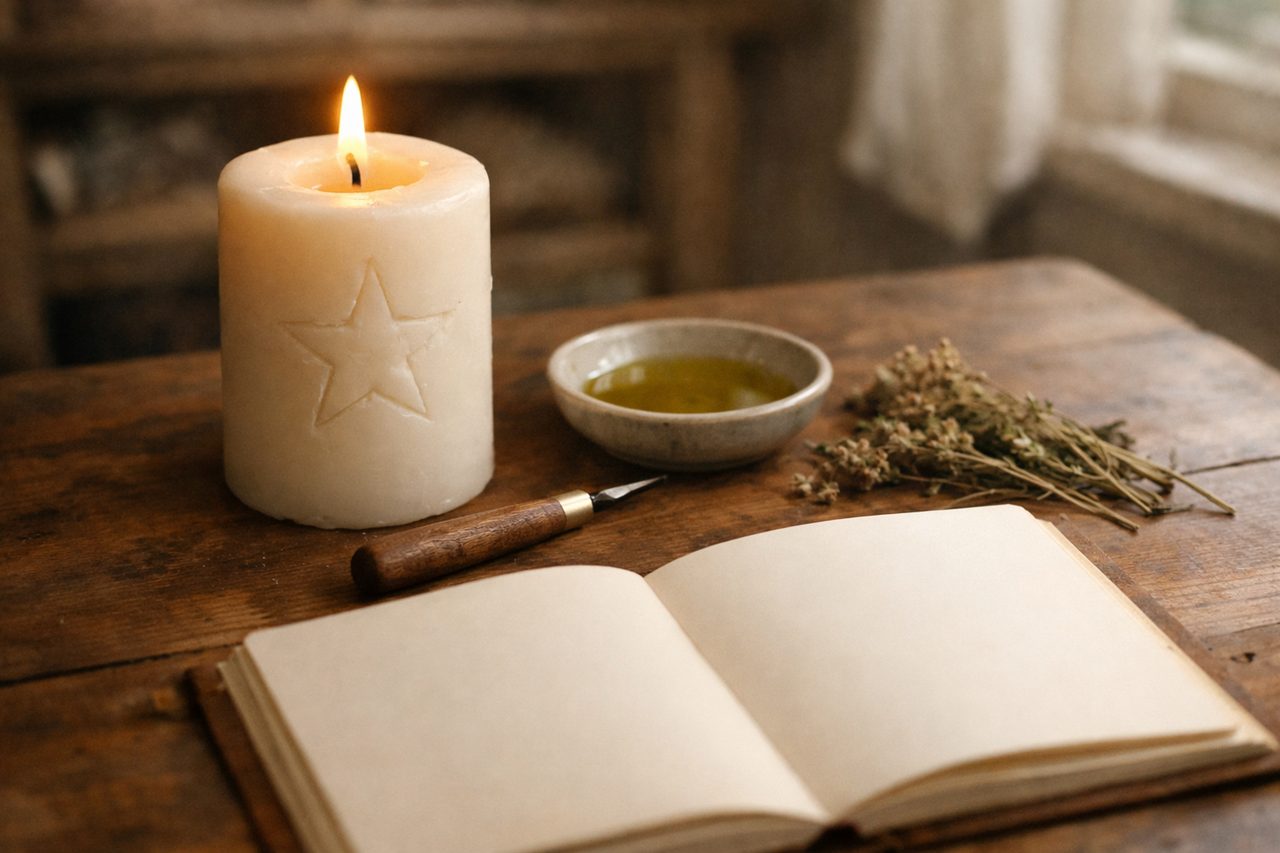
Symbols work best when they're part of a clear intention. Here are a few simple ideas:
- Carve a candle. Use a pin or toothpick to carve a symbol into a candle, then burn it while you focus on your goal.
- Trace it with oil or water. Draw a pentacle or hexafoil with a dab of olive oil or moon water over your front door. It's invisible and renter-friendly.
- Wear it. A pendant or ring keeps a symbol close as a quiet reminder of your intention.
- Combine them. Join runes or symbols into a single design, or turn your own words into a personal symbol. Our guide to sigils for newcomers shows you how.
- Use them in your Book of Shadows. Mark pages with element symbols or draw your own symbol key. Our Spell Crafting and the Book of Shadows course goes deeper into building one.
A Few Safety and Respect Notes
- Fire: never leave a carved candle burning unattended, and keep it away from curtains and dried herbs.
- Oils: dilute any essential oil before it touches skin, and keep oils away from pets, especially cats.
- Renting: don't carve into walls or woodwork that isn't yours. Use oil, water or chalk instead.
- Respect: symbols from living religions, like the ankh, the hamsa or Thor's hammer, mean a great deal to people today. Learn their stories and use them thoughtfully.
If you'd like to study symbols properly, from basic shapes to their use in ritual, our Wicca 101: Basic Signs and Symbols course is a gentle place to begin.
Final Thoughts
Witchcraft symbols are a beautiful, practical part of the Craft. A five-pointed star, three moons or a little daisy wheel scratched near the door can carry more meaning than a whole page of words. Start with one or two that speak to you, learn their history, draw them often and see how they feel in your hands and your home. Trust what feels right.
Which witchcraft symbol do you feel most drawn to, and how do you use it? Share it with us in the comments!
Sources
Cunningham, Scott. Wicca: A Guide for the Solitary Practitioner. Llewellyn Publications, 1988.
Graves, Robert. The White Goddess. Faber and Faber, 1948.
Hoggard, Brian. Magical House Protection: The Archaeology of Counter-Witchcraft. Berghahn Books, 2019.
Pinch, Geraldine. Egyptian Mythology: A Guide to the Gods, Goddesses, and Traditions of Ancient Egypt. Oxford University Press, 2004.
Hutton, Ronald. The Triumph of the Moon: A History of Modern Pagan Witchcraft. Oxford University Press, 1999.
Check out our other articles:
Sigils for Newcomers
Protection Spells for Your Home
Who are the Moon Goddess and the Horned God?
Rune Casting 101
See All Articles
Love this article? Share the magick with your friends and loved ones!
Witchcraft Symbols FAQs
What are the most common witchcraft symbols?
The most common witchcraft symbols are the pentacle, the triple moon, the Horned God symbol, the four elemental triangles, the triquetra and the spiral. Many witches also use runes, the ankh and folk protection marks like the hexafoil.
What is the strongest protection symbol in witchcraft?
There's no single strongest symbol. The pentacle is the most widely used in Wicca, while the Algiz rune, Thor's hammer, the Eye of Horus and the hexafoil are all popular. The best protection symbol is the one you understand and feel connected to.
What is the difference between a pentagram and a pentacle?
A pentagram is a five-pointed star. A pentacle is a pentagram inside a circle, and the word also names the flat engraved disc used on a Wiccan altar.
What does the triple moon symbol mean?
The triple moon shows a waxing crescent, a full moon and a waning crescent. It represents the Goddess and the cycle of the moon, and many witches link it to the Maiden, Mother and Crone.
What are Wiccan symbols?
Wiccan symbols include the pentacle, the triple moon, the Horned God symbol, the elemental triangles and tools like the cauldron and besom. They represent the Goddess and God, the elements and the cycles of nature.
Is the pentagram a bad symbol?
No. The pentagram has been used for many centuries with positive meanings, including by medieval Christians. In Wicca it represents the four elements plus spirit and is a symbol of protection and faith.
Can I use symbols from other cultures?
Many symbols, like the ankh, Eye of Horus or hamsa, belong to living cultures and religions. If you use them, learn their origins and meanings first and treat them with respect.
How do I activate a witchcraft symbol?
Draw or carve the symbol by hand while focusing on your intention, then charge it with candlelight, breath, moonlight or a few spoken words. Keep it where it can do its work, such as over a door or on your altar.